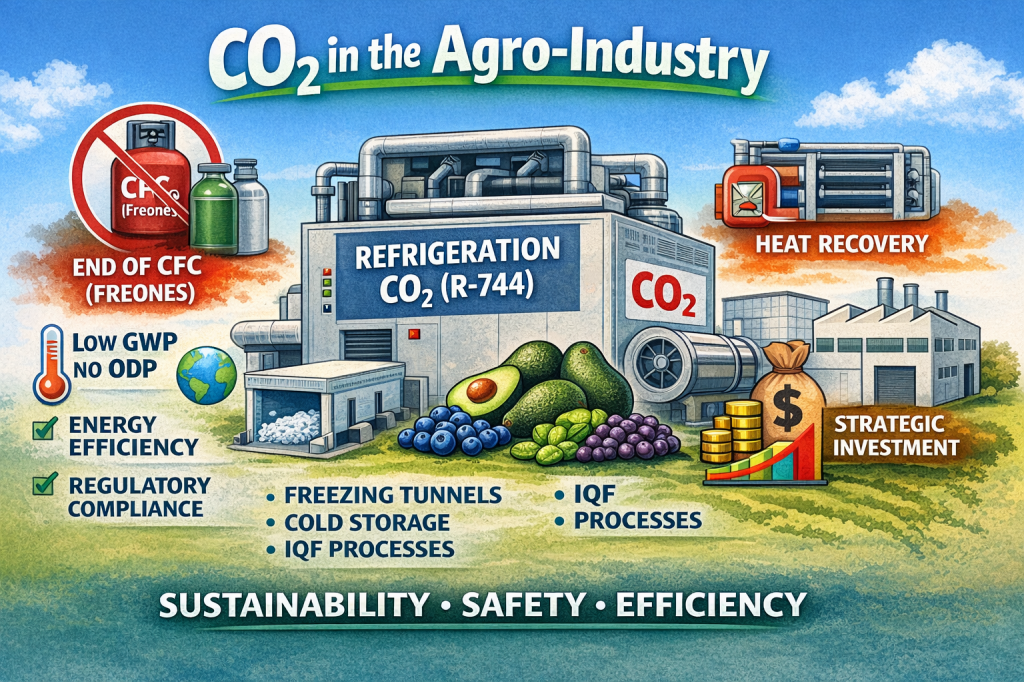
The agro-industry is one of the sectors where refrigeration is critical, not only for quality preservation, but also for food safety, operational continuity and regulatory compliance. In this context, CO₂ (R-744) is becoming established as a strategic alternative to the progressive phase-out of synthetic refrigerants (freons).
From an environmental perspective, CO₂ has an ODP of 0 and a GWP of 1, which makes it a refrigerant fully aligned with current and future regulations. This eliminates the regulatory risk associated with HFCs and HFOs, whose use will become increasingly restricted, costly or directly prohibited.
From a technical standpoint, CO₂ stands out for its high volumetric capacity, allowing for more compact equipment and smaller heat exchangers. This characteristic is particularly relevant in agro-industrial plants, where space availability, thermal efficiency and rapid system response are key factors.
CO₂ is especially competitive in medium- and low-temperature applications, such as:
- freezing tunnels,
- cold storage chambers,
- IQF processes,
- ripening centres,
- fresh and processed fruit and vegetable plants.
In temperate or cold climates, transcritical CO₂ systems can achieve high levels of energy efficiency. In warm climates, the incorporation of ejectors, mechanical sub-cooling or cascade systems (CO₂/NH₃) makes it possible to maintain competitive performance compared with traditional systems.
From a safety perspective, CO₂ is non-flammable and non-toxic; however, it operates at high pressures, which requires appropriate system design, certified components and trained personnel. In the agro-industry, this aspect is essential to comply with standards such as BRC, FSSC 22000 and international customer audits.
From an economic point of view, CO₂ systems generally involve a higher initial CAPEX, but this is offset by:
- lower refrigerant cost,
- regulatory stability,
- reduced risk of obsolescence,
- optimised energy efficiency in well-designed systems.
Another relevant aspect is energy integration: CO₂ systems allow efficient heat recovery, which can be used for domestic hot water, washing processes or pre-heating, thereby improving the overall energy balance of the plant.
In the modern agro-industry, CO₂ is no longer just a technological option, but becomes a strategic component of the new refrigeration matrix, particularly for greenfield projects or for plant modernisation with a long-term vision.
 FIMA AGROINDUSTRY CONSULTING