Mechanical refrigeration is based on the use of a refrigerant as a medium to extract heat from a product, an environment or an industrial process, operating through changes in pressure and temperature that allow heat to be absorbed and released within a closed cycle. Historically, the first refrigerants used were natural ones, mainly ammonia (NH₃) and carbon dioxide (CO₂), both employed since the late nineteenth century.
Ammonia still stands out today for its excellent thermodynamic performance, high coefficient of performance (COP), and its ability to operate efficiently across high, medium and low temperature ranges, although it requires rigorous technical handling due to its toxicity at high concentrations. CO₂, for its part, is also a natural refrigerant with minimal environmental impact, but it operates at high pressures and exhibits particular thermodynamic behaviour that demands specific designs and control systems.
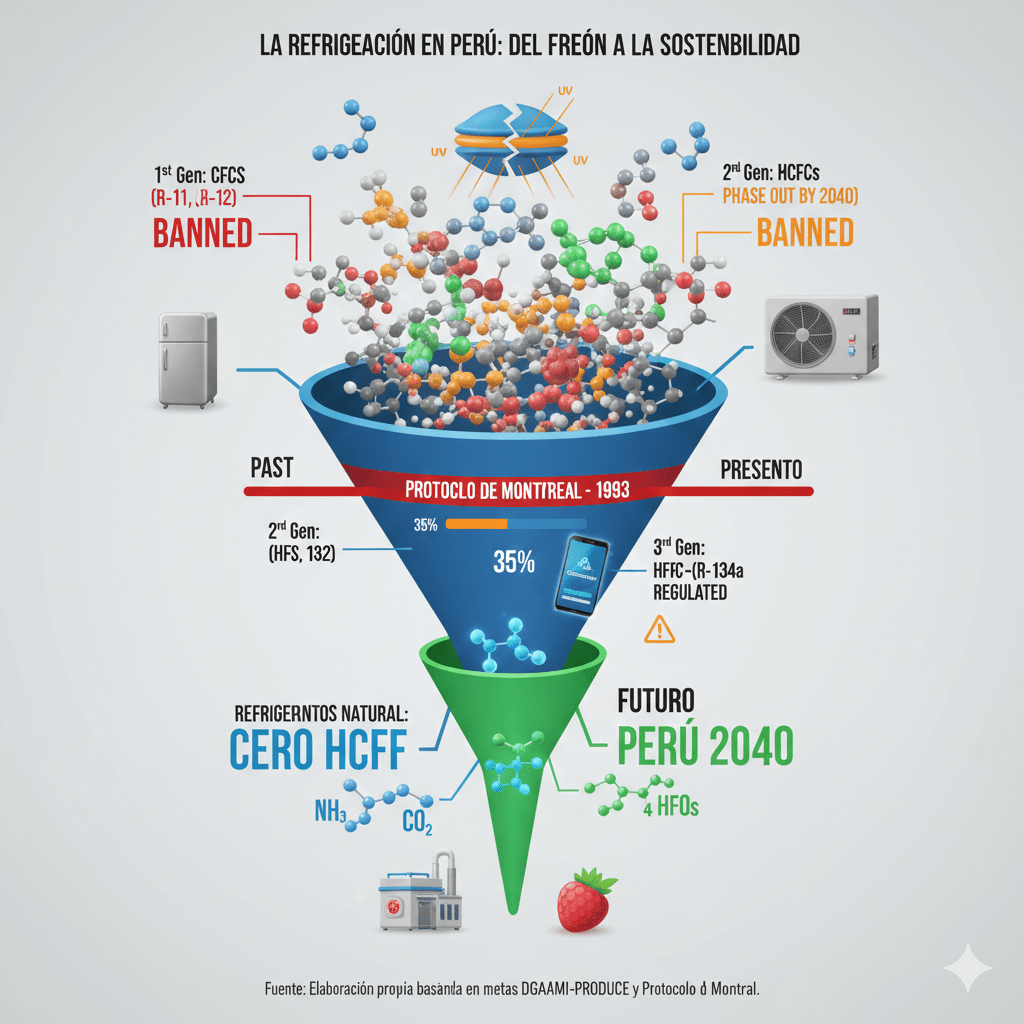
Due to the technological limitations of the early twentieth century, and the perceived risks associated with ammonia and the high pressures of CO₂, synthetic refrigerants or freons were developed, such as CFCs, HCFCs and later HFCs, which offered stability, low operational risk and ease of use. For decades, these refrigerants drove the growth of domestic, commercial and industrial refrigeration. However, over time it was proven that freons damage the ozone layer and contribute significantly to global warming, giving rise to international agreements such as the Montreal Protocol and their progressive phase-out. In Peru, this trend is clear: freons will become increasingly restricted, costly and regulated, while new projects are shifting towards natural refrigerants.
The future of industrial refrigeration in Peru is oriented towards systems designed with robust engineering, higher energy efficiency and lower environmental impact, where the choice of refrigerant is based on technical criteria rather than commercial convenience.
Added to this context is the environmental policy of the Peruvian State, which has set the goal of completely eliminating the use of HCFC gases by the year 2040, in compliance with the commitments assumed under the Montreal Protocol. The Ministry of Production (PRODUCE), through the Directorate General of Environmental Affairs for Industry (DGAAMI), leads this process by means of the progressive phase-down of these refrigerants, the control of imports, and the strengthening of technical capacities within the refrigeration and air-conditioning industry. Since 2015, Peru has already achieved significant reductions and continues to move forward with clearly defined intermediate targets.
La refrigeración mecánica se basa en el uso de un refrigerante como medio para extraer calor de un producto, un ambiente o un proceso industrial, funcionando mediante cambios de presión y temperatura que permiten absorber y liberar calor dentro de un ciclo cerrado. Históricamente, los primeros refrigerantes utilizados fueron naturales, principalmente el amoníaco (NH₃) y el dióxido de carbono (CO₂), ambos empleados desde finales del siglo XIX. El amoníaco destaca hasta hoy por su excelente comportamiento termodinámico, alto coeficiente de desempeño (COP) y su capacidad de operar eficientemente en rangos de alta, media y baja temperatura, aunque requiere un manejo técnico riguroso por su toxicidad en altas concentraciones. El CO₂, por su parte, también es un refrigerante natural con impacto ambiental mínimo, pero trabaja a presiones elevadas y presenta un comportamiento termodinámico particular que exige diseños y controles específicos. Debido a las limitaciones tecnológicas de inicios del siglo XX, y a los riesgos percibidos del amoníaco y las altas presiones del CO₂, se desarrollaron los refrigerantes sintéticos o freones, como los CFC, HCFC y posteriormente los HFC, que ofrecían estabilidad, bajo riesgo operativo y facilidad de uso. Durante décadas, estos refrigerantes impulsaron el crecimiento del frío doméstico, comercial e industrial. Sin embargo, con el tiempo se comprobó que los freones dañan la capa de ozono y contribuyen significativamente al calentamiento global, lo que dio origen a acuerdos internacionales como el Protocolo de Montreal y a su eliminación progresiva. En el Perú, esta tendencia es clara: los freones serán cada vez más restringidos, costosos y regulados, mientras que los nuevos proyectos migran hacia refrigerantes naturales. El futuro de la refrigeración industrial peruana se orienta a sistemas diseñados con ingeniería sólida, mayor eficiencia energética y menor impacto ambiental, donde el refrigerante se define por criterios técnicos y no por conveniencia comercial.
A este contexto se suma la política ambiental del Estado peruano, que ha definido como meta eliminar totalmente el uso de gases HCFC hacia el año 2040, en cumplimiento de los compromisos asumidos en el Protocolo de Montreal. El Ministerio de la Producción (PRODUCE), a través de la DGAAMI, lidera este proceso mediante la reducción progresiva de estos refrigerantes, el control de importaciones y el fortalecimiento de capacidades técnicas en la industria de refrigeración y aire acondicionado. Desde 2015, el Perú ya ha logrado reducciones significativas y continúa avanzando con metas intermedias claras. Asimismo, se promueve activamente el uso de tecnologías y refrigerantes alternativos más sostenibles. En este marco, iniciativas como el OzonoApp refuerzan la transición hacia una refrigeración más eficiente, segura y ambientalmente responsable en el país.
 FIMA AGROINDUSTRY CONSULTING