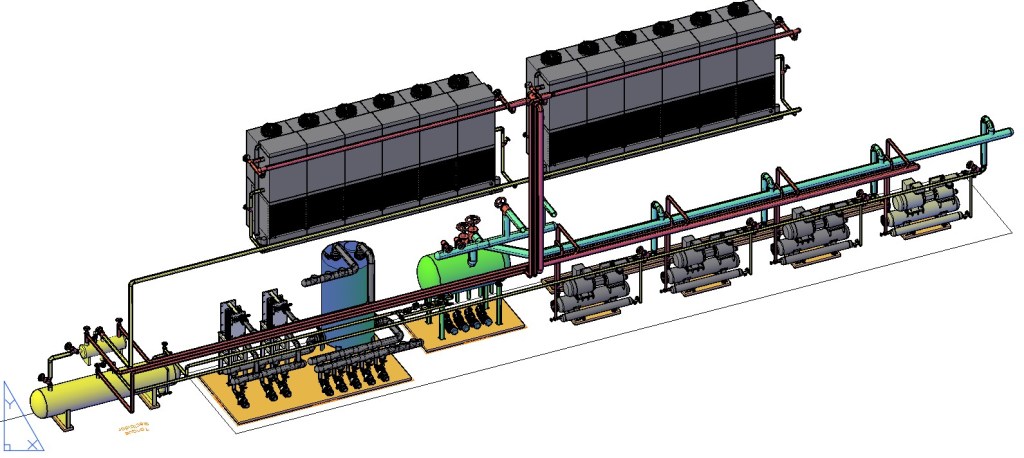
The machine room is the heart of any industrial refrigeration system. It houses the compressors, condensers, refrigerant vessels, pumps, electrical panels and safety systems. A mistake in its design not only makes the project more expensive, but can also compromise the operation, energy efficiency, and safety of the entire plant.
Therefore, detailed engineering is not a luxury: it is an essential requirement before tendering and construction.
Why is detailed engineering key?
Well-developed detailed engineering allows you to:
Precisely define the actual capacity of the system (kW, TR, kg/h, m³/h).
Correctly select the type of refrigeration system: direct expansion, recirculation, flooded, single or double stage.
Determine the most suitable refrigerant (ammonia, CO₂, cascade systems, etc.) based on safety, COP and electricity consumption.
Design a safe, operable and maintainable machine room that complies with technical and safety standards.
Avoid oversizing (high CAPEX and OPEX) or undersizing (operational failures and unscheduled downtime).
Without detailed engineering, there is no common technical basis for quoting, and each supplier proposes ‘their own solution’.
🧠 What defines detailed engineering in an engine room?
Before any tender, engineering establishes:
- Complete calculation of thermal loads.
- Refrigerant flow diagrams (P&ID).
- Selection and sizing of:
- Compressors
- Condensers
- Evaporators
- Separators, vessels and pumps
- Final layout of the machine room (spaces, access, maintenance).
Design of:
- Electrical system (MV and LV)
- Ventilation and gas extraction
- Fire protection system
- Drainage and spill containment
- Safety criteria and regulatory compliance.
👉 Engineering defines the system that is needed; the supplier only quotes.
 FIMA AGROINDUSTRY CONSULTING